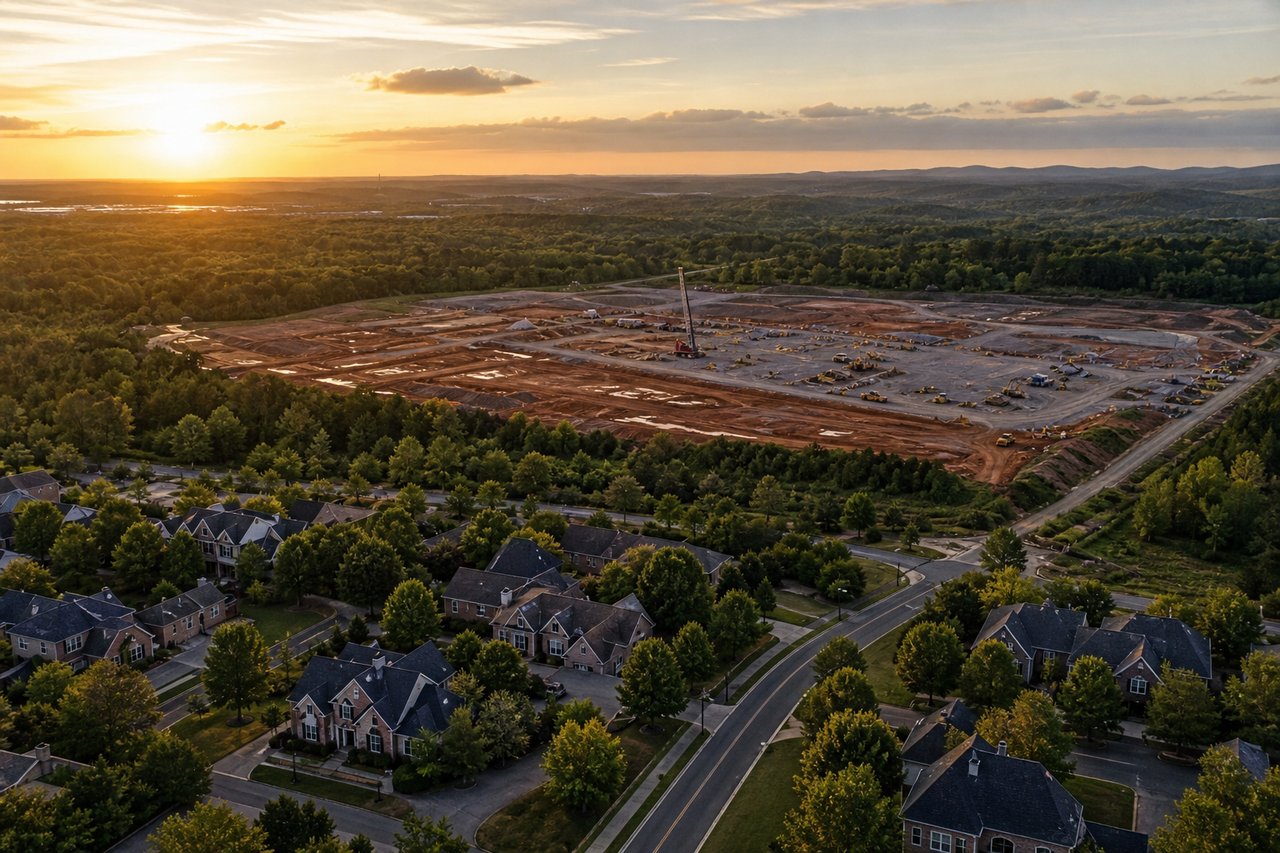
UCB's $2 billion pharmaceutical manufacturing facility at Rowen in Gwinnett County is projected to generate $5 billion in economic impact and 330+ permanent jobs, making it one of the largest industrial anchors in North Metro Atlanta's recent history, with meaningful implications for nearby residential property values and investor positioning over the next several years.
Will UCB's Rowen plant raise home values in Gwinnett County?
UCB's $2 billion pharmaceutical biologics manufacturing facility at the Rowen innovation district in Gwinnett County is projected to generate roughly $5 billion in total economic impact and create more than 330 permanent jobs and 1,000+ construction positions, according to Gwinnett County's official announcement. Projects of this scale, a multi-year, high-wage industrial anchor, have historically pushed residential demand upward in surrounding submarkets, though the timeline here is long and the effect will unfold in phases, not overnight.
What the UCB-Rowen Deal Actually Looks Like
Before we talk real estate, let's be clear on what this project is and isn't.
Rowen is a 2,000-acre innovation and knowledge community in Gwinnett County. UCB, a global biopharmaceutical company, purchased a 79-acre parcel within that district for a reported $14.3 million, according to April 2026 reporting by the Atlanta Journal-Constitution. The facility will be UCB's first U.S. pharmaceutical biologics manufacturing site, which is a significant designation, not a distribution warehouse or a call center.
The construction timeline is six to seven years, per the AJC's coverage. That matters for how you think about this as an investor or homeowner. You're not buying into a finished employment hub. You're positioning ahead of one.
Gwinnett County has been deliberate in comparing Rowen to Research Triangle Park in North Carolina, which transformed the Raleigh-Durham region's housing market over decades. That comparison is aspirational, but it's grounded in a real pattern: large-scale, high-wage employment anchors tend to attract more employers, which attracts more workers, which drives housing demand in surrounding areas.
The Three Phases Worth Watching
Based on the project's scale and timeline, the real estate story here plays out in roughly three stages:
- Near-term (now through construction ramp-up): Land speculation and investor attention near Rowen. Rental demand from construction workers and contractors. Early positioning by buyers who want to get ahead of the curve.
- Mid-term (as the facility takes shape): Infrastructure improvements, ancillary business growth, and increasing employer interest in the Rowen district draw more attention to surrounding residential markets. Rental demand from incoming professionals begins to firm up.
- Long-term (post-completion): 330+ permanent, high-wage pharmaceutical jobs generate sustained housing demand. Owner-occupant interest deepens. Property values in the closest submarkets reflect the matured employment base.
None of this is guaranteed, every major development faces delays, regulatory hurdles, and market shifts. But the capital committed ($2 billion), the county's backing, and the employer's profile make this one of the more credible long-range catalysts I've seen in North Metro Atlanta.
What This Means for Buyers and Investors Right Now
Here's how I'm thinking about this with clients who are asking me about Rowen's impact.
The areas most likely to feel the pull are the Gwinnett County communities already within reasonable commute distance of the Rowen site. Buford, in particular, sits in a strong position. Recent Zillow market data shows Buford's median sale price at $465,000 with a median of just 29 days on market, making it one of the faster-moving submarkets in the region. With 571 active listings and 326 homes sold in the trailing 90 days, the market has real liquidity, which matters if you're an investor thinking about exit timing.
For a broader view of where North Metro Atlanta markets stand today, here's the current picture across the areas I work most:
Area | Median Sale Price | Median Days on Market |
|---|---|---|
Sugar Hill | $463,500 | 52 |
Suwanee | $620,000 | 42 |
Buford | $465,000 | 29 |
Duluth | $437,000 | 52 |
Cumming | $613,807 | 20 |
Alpharetta | $751,000 | 36 |
Lawrenceville | $378,000 | 22 |
Johns Creek | $710,000 | 44 |
Source: Zillow sales data, trailing ~90 days, as of August 2026. Area-level medians, individual home values vary by condition, street, build year, and timing.
Lawrenceville stands out as the most accessible price point in the table, and it's also well-positioned geographically relative to Gwinnett's growth corridors. Suwanee and Cumming attract buyers who want more space and are willing to pay for it. Each of these markets has its own dynamics, and the Rowen effect will hit them differently depending on how the district develops over time.
For a broader market backdrop: a June 2026 report from Redfin's North Atlanta housing market data showed home prices up 12.0% year over year, with a regional median sale price of $857K for the three months ending June 2026. That's a regional aggregate and not a neighborhood-level benchmark, but it reflects the underlying demand pressure already present in the broader Atlanta market before Rowen's full effect materializes.
For Investors: Think Acquisition Strategy, Not Just Deal Hunting
A project like this can create noise, speculation, inflated asking prices on properties that don't yet justify them, and buyers chasing a story rather than a number. I've walked clients through enough of these cycles to know that acquisition strategy and long-term wealth planning matter far more than simply being first to a market.
The investors I work with who do well in situations like this are the ones who identify the right asset type (single-family rental, small multifamily, land), understand the carry costs during a long construction cycle, and don't overpay on the front end because of excitement. The opportunity is real. The discipline to execute it well is what separates the wins from the regrets.
If you want a deeper look at how I think about this market from an investor's perspective, my post on investing in Buford, GA in 2026 and the broader framework I use for real estate wealth building in North Metro Atlanta are good starting points.
For Homeowners Near Rowen: What to Know Before You Sell
If you already own near the Rowen corridor, the question I get most is: should I sell now or wait for values to rise?
Honest answer: it depends entirely on your situation. A six-to-seven-year construction timeline means values near Rowen are more likely to appreciate gradually than spike immediately. If you're sitting on equity and your life circumstances call for a move, waiting for a development to fully materialize isn't always the right call. If you have flexibility and a long horizon, the case for holding is stronger.
What I tell every seller I work with is that your specific number, what you'll net, what timeline makes sense, what your next move looks like, can't be answered by a blog post. It requires a real conversation about your home's condition, your neighborhood's current comps, and where you're headed next. That's the conversation I'm here to have.
One process note: Georgia residential transactions involve a closing attorney (Georgia is an attorney-closing state), a Transfer Tax, and Seller's Property Disclosures. If you have questions about what disclosures apply to your specific property near a large industrial development, that's a conversation for your closing attorney, not something to guess at.
Frequently Asked Questions
Will UCB's Rowen plant raise home values in Gwinnett County?
It's a reasonable expectation over time, but not a certainty and not immediate. The facility is projected to take six to seven years to build, per the Atlanta Journal-Constitution, and the $5 billion in projected economic impact cited by Gwinnett County will materialize in phases. Large employment anchors historically support residential demand growth in surrounding areas, but the timing and magnitude depend on how the broader district develops, infrastructure investment, and market conditions at the time.
Which North Metro Atlanta neighborhoods are closest to Rowen?
Rowen sits within Gwinnett County, placing communities like Buford, Suwanee, Lawrenceville, and Duluth within reasonable proximity. Each has its own market dynamics, Buford currently shows a median sale price of $465,000 and a 29-day median days on market, while Lawrenceville is the most accessible at $378,000 based on recent Zillow data. Your best positioning depends on your budget, investment goals, and how close to the site you want to be.
How long will construction of the UCB Rowen facility take?
The UCB facility is expected to take six to seven years to build, according to reporting by the Atlanta Journal-Constitution. This makes it a long-horizon investment catalyst rather than a near-term market mover. Buyers and investors positioning around Rowen should plan for a multi-year runway before the full employment and housing demand effects are felt.
What is the difference between Rowen and the UCB manufacturing site?
Rowen is a 2,000-acre innovation and knowledge community in Gwinnett County designed to attract research, life sciences, and technology employers. UCB's manufacturing facility occupies a 79-acre parcel within that larger district. Think of Rowen as the master-planned campus and UCB as the first major anchor tenant, with the expectation that additional employers will follow over time, per Gwinnett County's project announcement.
Is Gwinnett County expected to see more jobs and housing demand from Rowen?
Yes, based on the project's stated projections. Gwinnett County projects 330+ permanent jobs and 1,000+ construction jobs from the UCB facility alone, with a total economic impact estimate of approximately $5 billion. If additional employers follow UCB into the Rowen district, which is the district's stated goal, cumulative housing demand in surrounding Gwinnett communities could grow meaningfully over the next decade.
The Bottom Line
UCB's $2 billion commitment to Rowen is one of the most significant economic development announcements Gwinnett County has seen in years, and it has real implications for how I'm advising buyers, sellers, and investors across North Metro Atlanta right now. The opportunity is long-dated, not instant, but the investors and homeowners who understand the timeline and position accordingly are the ones who tend to look back at moments like this and feel good about their decisions.
If you want to talk through what this means for your specific situation, whether you're looking to buy near Rowen, sell before the area heats up, or build a portfolio around Gwinnett's growth, reach out and let's set up a conversation. I work this market every day, and this is exactly the kind of analysis I bring to every client relationship.
Equal Housing Opportunity. Each office is independently owned and operated. Hersh Shah Group is licensed with Keller Williams Intown Atlanta, regulated by the Georgia Real Estate Commission. This article is general information only and is not legal, tax, or financial advice. Readers should confirm their own numbers and circumstances with a licensed attorney, tax advisor, lender, or closing officer before making any real estate decision.